
Digital Investment Prioritization Framework (DIPF)

Recently, I had the opportunity to spend a considerable amount of time with a group of senior executives of a major media conglomerate. We discussed about modernization of the technology infrastructure to support the business growth of the organization; primarily in the digital space.

I was supported by our technology team that deals with application modernization. The team carried out a technology assessment study and came to the conclusion that a good 60% of the technology infrastructure will need to be replaced to support digital growth. It was a slam dunk business case- at least so was the team thought.

Within a few days, we heard back from the CFO who was asking for the business justification for the modernization spend. It turned out, to the surprise of many, that the business cases are not so much slam dunk as they were thought to be. There were issues with ROI with some of the business cases. But the bigger problems were around prioritization of initiatives between “Enhancing Consumer Experience” vs “Improving Digital Operation”.

Unfortunately, this is not an isolated business situation at all. Despite the fact, that digital transformation is a must for most companies, organizations have been struggling to prioritize to maximize ROI on their digital investment. Many a times, it become a game of power play, with the functions having better clout at the moment, corner a higher percentage of the investment in their favor.

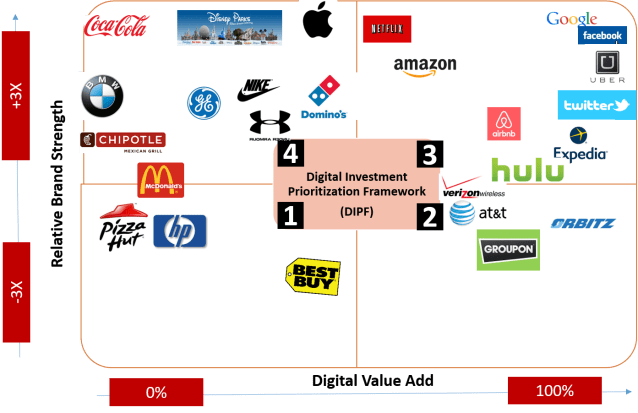
Looking at this problem of prioritization between “Consumer Experience” and “Digital Operation”, we decided to put a simple 2X2 matrix that could drive the investment prioritization decision . We can call it “The “Digital Investment Prioritization Framework” or DIPF.

For the X axis of the framework, we used a parameter of “Digital Value Add”. This value defines the degree to which digital is important to a brand’s core offering (Current). We can use a scale of 0% to 100%. The value of 0% signifies digital has little to no value-add to the brand, where as 100% means that all of the value of the brand is coming from digital.

For Y axis, we used a parameter called “Relative Brand Strength”. This value signifies the current brand strength compared to a brand’s nearest competitor. We can put a scale of -3X to +3X ,which would hopefully can handle most brands within a segment. (This scale could be adjusted)

The idea is to put any brand in one of the four buckets created by this 2X2 matrix and drive the digital prioritization initiative through that grid. To illustrate, we have put some example companies in the four grids that could be used as template. (People may disagree with the placement of the brands in the grid. This placement is purely based on my judgement at this moment)

Grid 1- Here you have a situation where the brand strength is low and digital value add is also small. This group is an extremely vulnerable group and something must be done to enhance the consumer experience through digital value adds. Brands in this group should consider digital operation as secondary, unless it is directly liked with consumer experience.

Take for example the case of Pizza Hut vs Domino’s. Pizza Hut has been struggling with its digital strategy forever. In contrast, Domino’s have leapfrogged in digital experience. Right from social strategy to “order to deliver” experience, Domino’s is a winner in digital. The impact digital has made on Domino’s brand, is for every person to see.

Another example in this grid is a company like Best Buy. Cornered by Amazon, Best Buy has lost much of it sheen. As an electronic retailer it should have a strong digital strategy, but it has failed to gear up to the challenge. The brand, as a result is struggling. Brands such as Blockbuster got obliterated because they could not add digital in their value. This grid is a place of opportunity as well. Many commodity products ranging from fans to light bulbs are adding IOT capabilities and breaking out from grid 1 to grid 4.
Picture 1

Grid 2- This grid comprises of companies that are mostly born out of digital revolution. However, there could be multiple problems in the group. One problem could be the fact that the industry itself is reaching the commodity status because the services are utility in nature.

Take the case of broadband service providers in the consumer space. There is not much to differentiate among Verizon, AT&T or Comcast broadband services, but what makes the difference for the consumer is the quality of the service which is defined by their operational excellence. If the broadband goes down three times a day, no amount of peripheral digital consumer experience is likely to cut it. For this group, digital operation remains a priority. Alternate way of getting out of grid 2 to and move onto grid 3 is to come up with new business models that could monetize the broadband service in all together different ways.

Or take the case of Orbitz. This online travel solution provider is finding it hard to distinguish itself in a commodity market place, which is dominated by Priceline. For a company in this kind of predicament, it could be ideal to look for additional business models as source of revenue. It may not be good enough to concentrate on either consumer experience or operational excellence to survive.

Grid 3- This grid consists of companies that we call “born-digital”, “digital native” or “born to be digital”. This group includes tech companies such as Google, Facebook, Twitter, Uber etc. Majority of the value of these companies is coming from digital. And there is companies like Netflix and Amazon which probably draw 40% value from content/products and 60% from digital.

These companies need to spend equal amount in digital operation and consumer experience. You can’t afford to have Facebook application down for hours. At the same time, the consistent upgrade in consumer experience keep these brands ahead of any potential competition. (Remember how My Space died)

Grid 4- This grid consists of two kinds of companies. There are handful of companies who has a physical brand that’s hard to dislodge. One good example would be Disney parks. It won’t matter to consumers whether Disney park App is working or not for someone to visit the park. Then there are other kind of companies such as Nike or Under Armor, which have invested heavily in digital experience to break out from all other fitness apparel firms in the world. For either of these groups, investment in consumer experience remains a priority over investment in digital operation.

DIPF_strategy

To summarize, companies who are high on digital value, have to focus more on digital operation compared to companies who are less on digital value. The priority on digital investment for organizations will change from Consumer Experience to Digital Operation as brands derive increasingly more value from digital.


The Parameters of Success for the Sharing/Marketplace Economy of Uber & airbnb

Last week when I called for an Uber, a gentleman in his swanky new BMW arrived at my doorstep. Now it is not uncommon to get a ride in an expensive new car when you call for an Uber. But what struck me the most was the demeanor of the driver. He was a polished guy in his mid 40s, wearing designer clothes and watches and do not seem to have any particular reason to drive a car on a weekend for extra money.

Eventually curiosity got the better of me and I had to ask him whether driving Uber is his main job. As I expected, he turned out to be a senior manager with a very large tech company. However, he explained that as he is going through a costly divorce, this is his way of getting back to decent financial health at the quickest possible way. .

However, this is not an isolated case. Over the last 12 months that I have used Uber, I have been driven by among others, a financial analyst from the Wall St., a ground engineer from United Airlines and a practicing lawyer from a reputed law firm. And it goes to show beyond doubt that in a “Sharing Economy” or a marketplace economy, whichever way you want to call this system, the general expectation of the product and service may not hold good. The question is, whether a sharing economy can provide a consistent value to its participants that will eventually make it win over the traditional products and services and make them completely redundant.

We all know that Uber is not an isolated business case that are all witnessing here. Airbnb, Etsy are growing at pretty rapid pace too and I am sure more soon will follow. Question is, can we put together a set of general principal that could indicate the chances of success of these new services?

Based on my observation, I have boiled down the chance of success on five key parameters. And I will take the example of Uber and few others to illustrate these parameters.

First parameter for success is the Supply and Demand Equilibrium. If the supply side is limited, the system may not work efficiently, as suppliers will hoard to get a better price. If buy side is limited, then the supplier will undercut each other and it will take the market down. This is not to say there should be equal number of sellers as there are buyers. It’s more about the number of either side which can promote a true marketplace behavior. If demand and supply is in equilibrium, market will operate at optimum inventory, the cost of sales will be largely distributed and overall dollar for dollar a buyer will get a better product/service.

The Second most important parameter of success is Transparency. Given, the product/service will be a marketplace product/service and for that matter branding may play a diminished role, it is important for buyers and sellers know exactly what they are buying and who they are buying/selling to. Take the case of Uber. Isn’t it a great comfort for everyone just knowing in advance the make/model of the car? Similarly for Airbnb, the quality of video and picture makes huge difference in the buying process. However, it is not only the transparency about the product. Transparency about buyer/seller detail, transparency about payment processing, transparency about grievance redressal, all pay critical role in the success of this economy. One crucial outcome of transparency is consistency. Transparency always weeds out the non-performers thus enhancing the consistency of the services.

The Third most important parameter is Convenience. A marketplace may provide a better value for the buck, but it is not always guaranteed that it is more convenient. However, if the convenience factor could be added to the product/service, it could enhance its value significantly. This is off course is the trump card for Uber. The ease of app use is a huge positive for Uber. The other not so talked about feature is the smart planning of Uber to get the tipping business out of the way. The fact that you could just walk away after taking the ride without taxing yourself how much to tip the cab driver based on his service quality is a big relief to many.

The Fourth most important factor is Complexity of the business model. When you are dealing with mass population, it is but given that higher complexity of business model is a recipe for disaster for a marketplace economy. Hence the simpler it is for the buyers and sellers to understand and execute the process, the better are the chances of success. It’s no coincidence that all marketplace economies such as eBay, Uber, Airbnb, etsy have the most simple business model. Particularly important in this case is the sell side complexity, as this could drastically reduce the service providers in the marketplace.

This bring us down the Fifth and the most important parameter of Risk. In Most marketplace economies, the primary risk of service quality or product usage is mitigated through user reviews. However there are graver form of risk such as physical harm or legal liability that could drag down this economy quite easily. In this hyper-connected social world that we live-in and where bad information could spread like a wildfire, management of Risk remains the single most important parameter that will determine the success of the sharing economy.

End of Net Neutrality- Winners and Losers

In case you are not following what is this big commotion about “End of Net Neutrality”, here is a short summary. I also have picked my winners and losers in the ecosystem because of abolition of this rule.

For people unfamiliar with the basic concept of Net Neutrality, it refers to the policy that ensures internet service providers (ISPs) such as Verizon, Comcast, AT&T etc. to offer equal quality of service to all business seeking to leverage internet as its distribution medium. To illustrate, Comcast isn’t expected to cut a deal with Netflix for faster speed of delivering content compared to YouTube content. One must note that Net Neutrality has nothing to do with consumer pricing by the ISPs. As probably you have already seen, that the ISPs already charge higher prices to the consumer for better quality internet service.

I am not going to go into detail about the legality of the situation or even why and why not of Net Neutrality. This blog will analyze how the stakeholders in the ecosystem will be impacted by the abolition of Net Neutrality.

Let’s start of this analysis with the Internet Service Providers (ISPs). With the abolition of Net Neutrality, the ISPs will be allowed to offer different levels of service to the business that wants to ride on its backbone. As a consequence, they will introduce new and differentiated products in the market and their revenue will go up. This ability to control price and service will increase their bargaining power and they probably will make more money even for the current service that they offer in the market. This is a game changer for them.

Now let’s look at how video distributors such as Netflix will be impacted. Netflix has been openly critical about abolition of Net Neutrality. On one hand, more bargaining power for the ISPs may naturally mean less bargaining power for the video distributors. That may be the reason why Netflix does not support it. On the other hand, this ruling will severely constrict possibility of any new video distributor coming in the market. That will definitely benefit Netflix. The only problem is that, all ISPs such as AT&T, Verizon and Comcast are video distributions as well. As a result the benefit that Netflix will get because of less competition in the OTT space (Read broadband), will be nullified by the greater play by the ISPs as content distributors.

Among other video distributors, the one who has subscription or end user based revenue will gain more compared to the ad based service providers. Imagine the case of you tube. With billions of users and low value high volume videos, it might find it difficult to cut an economic deal with the ISPs. In contrast iTune which primarily deals with end user revenue could have easier opportunity to deal with ISPs for higher bandwidth. All in all content model riding on eyeballs will be negatively impacted.

For content creators/owners such as Studios and TV networks (Warner, Fox, Disney, NBCU, Sony), this is a mixed news. Lack of new entrants in the content distribution space will make the existing video distributors stronger. Also, more bargaining power to the ISPs even in the OTT space mean the revenue share of content owners could shrink. However, as explained in the earlier paragraph, the abolition of Net Neutrality may negatively impact the YouTube like business model of ad based revenue on non-premium media. That could mean that premium video will get a lift in the market. Another silver lining for the studios in this issue is that with Net Neutrality gone, content piracy could be badly hit. One can’t expect pirated content sites to cut a deal with Comcast for fast lane distribution.

For consumers, this is only a bad news. Abolition of Net Neutrality will drastically reduce the innovation and competition in the video distribution market. As a consequence we will see price rise for both content and access. However with content piracy gone, your computer might get less infected by computer virus (Just kidding)

To summarize, if you are an investor, go long on Comcast, AT&T and Verizon. Hold Disney and Turner. Sell your Netflix Shares and be ready for some austerity measures at home.


“Right to be Forgotten”- The Implication of Mario Costeja Gonzalez vs Google case verdict

Luxemburg court of Justice for European Union has delivered a very controversial verdict on internet privacy last week (13th of May 2014). The specific verdict refers to a section of the privacy law that defines a concept of “Right to be forgotten” which allows individuals the right to remove personal information available on the internet if there is no legitimate ground to retain it. The verdict has been heavily criticized by the advocates of freedom of information and welcomed by the staunch privacy supporters.

The case in point here is related to one Mario Costeja Gonzalez, a resident of Spain who had to auction his house 16 years ago to pay for his social security debts. This information continues to appear on search results, which as per Mario have damaged his reputation. He has been fighting a case against Google for long to remove this specific information from the search results. With this verdict, the court has agreed with his reasoning and asked Google to remove this content from its search results.

The verdict has a far reaching implication on how personal information might get censored in future, particularly for individual living within European Union. Interestingly enough, the proposed legislation, which formed the basis of this verdict, is barely in its draft stage. Led be Vivian Reading, European commissioner of Justice, the commission released its 1st draft in January 2012 and is expected to undergo further negotiations among participating countries. The verdict as a result has set a nice precedence on a relatively fledging piece of legislation.

Let us now look at what exactly the draft proposal says about “Right to be forgotten”. On page 26 point 53 of the draft it states the following

“Any person should have the right to have personal data concerning them rectified and a ‘right to be forgotten’ where the retention of such data is not in compliance with this Regulation. In particular, data subjects should have the right that their personal data are erased and no longer processed, where the data are no longer necessary in relation to the purposes for which the data are collected or otherwise processed”………. “However, the further retention of the data should be allowed where it is necessary for historical, statistical and scientific research purposes, for reasons of public interest in the area of public health, for exercising the right of freedom of expression, when required by law or where there is a reason to restrict the processing of the data instead of erasing them.”

Overall, we can summarize the concept as the following. “If individual’s right to erase his personal information is higher than that of public’s interest right to find it, data could be asked to be deleted”.

Personally I like the concept of individual data privacy. No one likes a personal mistake committed decades ago to hang around the neck and spoil his/her entire life. This is even more important for cases where unauthorized personal data such as pornographic material is distributed through the internet which ruins many lives.

However, all cases may not be that straightforward, the question therefore is who and how it is decided whether in a particular case individual’s right is bigger than the public interest?

To understand how the legislation propose to tackle the above question let’s first understand a few important concepts of the legislation.

As far as who is the responsible party that will be held accountable for removal of data from the internet, the legislation introduces a concept of an entity called “data controller”. In this “right to be forgotten” law the buck literally stops at the data controller who seems to have all the responsibility to establish and execute the law. The law defines data controller as the following:

“controller’ means the natural or legal person, public authority, agency or any other body which alone or jointly with others determines the purposes, conditions and means of the processing of personal data”.

 We all know that Google data search is highly contextual; it controls the output through a very well defined process. Hence by definition it is a data controller. Interestingly enough, the privacy law does not touch upon the publishers at all as source of information and that is why some of the concepts seem confusing. For example point 53 on page 26 talks about deleting data or restricted access. Google or any other search engine may not have any jurisdiction for deleting any content except may be cashed data. All it can do is take down the links to the data.

The draft also has a concept of data processor that process data on behalf of the controller. In this case also the responsibility is with the controller. So if someone uses personal data derived through Google search and use that data, the responsibility will still be with Google.

However the most revolutionary part of this legislation comes on page 27 point 56 on burden of proof.

 “In cases where personal data might lawfully be processed to protect the vital interests of the data subject, or on grounds of public interest, official authority or the legitimate interests of a controller, any data subject should nevertheless be entitled to object to the processing of any data relating to them. The burden of proof should be on the controller to demonstrate that their legitimate interests may override the interests or the fundamental rights and freedoms of the data subject.”

On top of this burden of proof argument is the case of financial penalty. Article 79 that states supervisory authority, talks about a fine up to 500 000 EUR for individuals, or in case of an enterprise up to 1 % of its annual worldwide turnover. This fine is imposed to anyone who, intentionally or negligently does not comply with the “right to be forgotten” act.

To illustrate, if I want any of my personal content to go out of internet, I will ask Google to remove it. Google will have to decide whether my personal right is higher than public interest. If they don’t remove my data link, I can file a case against them and if they lose they will have to pay 1% of their annual turnover as fine.

Now Google specifically has very good takedown process of pirated content from the internet. Hence they may not have any problem in taking down the content if someone wants to do so. The problem is determining them on a case by case basis.

First Google will have to confirm the identity of the requestor. Secondly it has to establish that by taking down the information it is not violating anyone else’s constitional right. And thirdly, by removing the content it is not compromising any health or security issues. I suspect if Google is to perform all this actions it has to set up an equivalent of FBI and Scotland Yard in additional to employing couple of thousand lawyers in its premise. (In addition to the lawyers they already have)

In summary, while the legislation has a lot of merit, by imposing the burden of proof to the controller and creating a vague legislative structure in which the search provider has to work on, the EU has successfully passed the responsibility to Google. May be EU is hoping that by putting the ball on Goggle’s court, it could force the search giant to come up some proposed formula that could serve EU privacy cause in the long run.

In months to come we are likely to witness all kind of people ranging from financial imposters, crooks, convicted pedophiles to political criminals, who would seek refuge under this law. It would be interesting to see how Google will respond to those requests.

On a brighter side for Google, this might potentially open new business model for them. As more and more personal information is removed from Google search, people who need to run security clearance or journalistic research will probably need to approach the search engine for special closed loop search. These services would typically be business to business where Google already has an established revenue model

The irony of this entire episode is that since now Mario Costeja Gonzalez has become a public figure and could become the poster boy for the EU privacy law, chances are, his personal information will never go down from the internet. It is safe to say that his right to removal of his property auction data will be far outwitted by billion of people seeking privacy of their personal data, who will use Mario as a reference to their case.